Muncie Digital Marketing Agency
SUNRISE TO NOON LLC


On Top of the Rankings
a Sunrise to Noon Digital Marketing Agency Blog
Indiana Google Maps vs Organic SEO Guide | Sunrise To Noon
Google Maps vs. Organic SEO: Why Your Business Ranks in One but Not the Other
Quick Answer: Your business can rank high on Google Maps but poorly in organic search because Google uses different ranking factors for each. Google Maps focuses on your business location, services, and reputation, while organic search looks more closely at your website's content, relevance, and quality. A business can perform well in one and poorly in the other. To find out why, compare your rankings for the same keyword, check your Google Business Profile, and review how your website performs in Google Search.
Why Are Your Google Maps and Organic Rankings Different?
Your business appears near the top of Google Maps, but your website sits on page two of Google's regular search results. Or maybe your website ranks well, but your business barely appears on Maps.
This happens because Google Maps and organic search use different ranking systems. A business can have a strong Google Business Profile but a website that needs improvement, or the other way around.
The important question isn't just why your rankings differ. It's which part of your online presence needs attention and what evidence supports that conclusion.
Google Maps vs. Organic Search: What's the Difference?
Google Maps shows nearby businesses that match someone's search. These results often include business names, reviews, phone numbers, and directions. The group of businesses shown with a map in Google Search is called the Local Pack or Map Pack.
Organic search results are the regular website links that appear on Google. These may include service pages, homepages, blog articles, and other helpful websites.
Google Maps | Organic Search |
|---|---|
Shows local business listings | Shows individual website pages |
Focuses on relevance, distance, and prominence | Focuses on content relevance, usefulness, links, and website quality |
Uses Google Business Profile and other online information | Uses website content and other search signals |
Strongly affected by the searcher's location | Also affected by location, but depends heavily on search intent |
Helps customers call, visit, or get directions | Helps customers research services and visit websites |
Both can generate customers, but they don't always show the same businesses in the same order.
Why Does Your Business Rank on Google Maps but Not Organic Search?
If your business ranks well on Maps but your website struggles, the problem may involve your website's content, technical setup, or competing pages.
Your Website Doesn't Clearly Explain Your Services
Your Google Business Profile may list your services accurately, but your website might not provide enough information about them.
For example, an HVAC company in Muncie could rank well on Google Maps for "furnace repair Muncie" because its business profile matches the search.
However, if its website only has a short heating and cooling page, Google may show competitors with more useful furnace repair pages in organic results.
What to check: Look at the website page that should rank for the keyword. Does it explain the service, answer common customer questions, and make it easy to request help?
Google Has Trouble Finding Your Website Pages
Sometimes the issue isn't the content. Google may have difficulty finding or including important pages in its search results.
This can happen because of website settings that block indexing, broken internal links, or other technical problems.
What to check: Use Google Search Console to see whether your important service pages are indexed. If Google hasn't indexed a page, investigate that problem before rewriting its content.
Your Competitors Have Stronger Website Pages
A nearby business may perform well on Maps while competing against websites with more helpful content, stronger links, or a better match for the search.
For example, your homepage may be competing against a dedicated service page that explains pricing factors, common problems, and the service process.
What to check: Compare the pages ranking above yours. Look for information your page is missing and determine whether you're targeting the keyword with the right page.
Why Does Your Website Rank but Not Google Maps?
If your website ranks well but your Google Business Profile doesn't, your location, profile information, or local competition may explain the difference.
Your Business Is Farther From the Searcher
Distance is an important Google Maps ranking factor.
A company based in Muncie might have a helpful website page about services in Noblesville. That page could appear in organic results because it answers the searcher's question.
However, nearby Noblesville businesses may have an advantage in Google Maps because they're physically closer to the person searching.
What to check: Compare your Maps rankings from different locations. If your business ranks well nearby but poorly farther away, distance may be an important factor.
Adding more city names to your Google Business Profile won't change your actual location.
Your Google Business Profile Doesn't Match Your Services
Your website might clearly explain what you do while your business profile uses the wrong category or has incomplete service information.
For example, an electrical contractor may have a strong webpage about panel upgrades but an incorrect primary business category.
What to check: Review your primary category, secondary categories, services, and profile status. Make sure they accurately describe your business.
Competitors Have Stronger Local Reputations
Google considers how well-known a business is when ranking local results. Reviews, ratings, links, and other online information can contribute to this.
A competitor with a stronger local presence may appear above your business on Maps even when your website performs better organically.
What to check: Compare customer reviews, relevant online mentions, and business information. Focus on earning genuine reviews and keeping your listings accurate.
Also check for verification issues or duplicate listings that may need attention.
How to Diagnose Your Google Maps and Organic Ranking Gap
Before changing anything, compare your Google Maps and organic rankings for the same keyword.
For example, an HVAC company might check its rankings for "AC repair Muncie."
Ranking situation | What to check first |
|---|---|
Maps #2, Organic #18 | Is the correct service page indexed, relevant, and competitive? |
Maps #15, Organic #3 | Does the searcher's location affect Maps results? Are GBP categories correct? |
Maps #12, Organic #16 | Are both the profile and website relevant to the search? |
Maps #2, Organic #3 | Are those rankings generating calls, inquiries, and customers? |
These rankings are hypothetical examples, not actual client results.
The numbers alone don't tell you what's wrong. They show where to begin investigating.
Step 1: Check Google Search Console
Google Search Console is a free tool that shows how your website performs in Google Search.
Start by finding the keyword you're investigating. Review which page receives impressions for that search, its average position, and how often people click on it.
Then check whether the page is indexed.
If your service page isn't receiving impressions for an important keyword, first check whether Google has indexed it. If it is indexed, review how well the page matches the search and whether competing pages provide more useful information.
Step 2: Check Your Google Maps Rankings
Search for the same keyword on Google Maps and review how your business appears.
Remember that Maps results change depending on where someone searches. A ranking from your office may be different from a ranking several miles away.
Location-based ranking tools can help show where your business is visible across a city.
Check your business categories, services, reviews, and profile status before deciding what to change.
Step 3: Compare the Results
Now look at both sets of information.
If your Google Business Profile performs well nearby but your service page ranks poorly, focus your investigation on the website.
If your website ranks well but your profile struggles, examine your location, categories, reviews, and local competition.
If both perform poorly, review your overall service relevance, website quality, profile information, and competition.
This approach helps you choose improvements based on evidence rather than guessing.
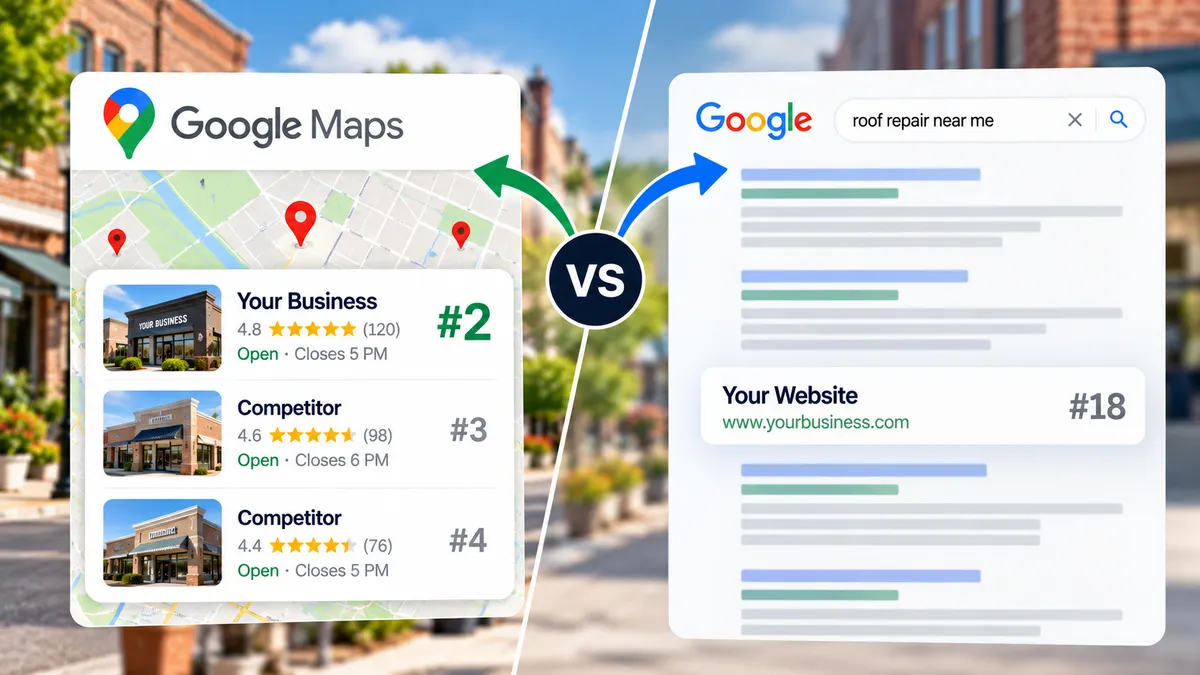
Example: Your Business Ranks #2 on Maps but #18 Organically
Imagine a roofing company in Central Indiana ranks #2 on Google Maps for "roof repair near me," but its website ranks #18 for a comparable local roof repair search.
The owner assumes the Google Business Profile needs more posts and photos.
However, the ranking gap doesn't automatically mean the profile needs work.
A proper review would begin with the website. Is the roof repair page indexed? Does it explain roof leak repairs, storm damage, and common repair questions? Are stronger competitors using dedicated roof repair pages?
Suppose Google Search Console shows the website is being found, but its general roofing page is competing against more detailed roof repair pages.
In that situation, improving the website's roof repair content may be a more useful first step than increasing Google Business Profile posting.
The lesson: A Maps ranking problem and an organic ranking problem require different solutions. Check the evidence before choosing one.
This is a hypothetical example demonstrating the diagnostic process, not a Sunrise To Noon client case study.
Not Every Keyword Needs Strong Maps and Organic Rankings
Another important difference is what the person searching actually wants.
Someone searching for "emergency plumber near me" probably wants to contact a nearby business quickly. Google Maps may be especially useful for that search.
Someone searching for "why does my water heater keep leaking" may want an explanation before hiring someone. An informative website page may be more useful.
A search such as "water heater replacement Muncie" can attract people who want to compare local businesses and learn about the service, making both Maps and organic visibility valuable.
This is why businesses shouldn't chase identical rankings for every keyword.
Focus on the search results that match the customer's needs and are most likely to bring useful inquiries.
Does Google Business Profile Optimization Help Organic SEO?
Improving your Google Business Profile can support your overall local online presence, but it doesn't automatically improve your website's organic rankings.
Your profile helps customers find your services, business information, and reviews. Your website explains those services in greater detail.
For example, adding furnace repair to your Google Business Profile helps describe what your company offers. A helpful furnace repair page can answer customer questions and support organic search visibility.
Both are valuable, but updating your profile doesn't replace website SEO.
How to Improve Both Google Maps and Organic Rankings
Once you understand the ranking gap, focus on the changes that address the actual problem.
Improve the Pages That Matter Most
Start with the services that bring valuable customers to your business. Make sure each important service has a useful page that clearly explains what you offer, who needs it, and how to contact you.
Check indexing, internal links, and competing pages before creating more content.
Keep Your Google Business Profile Accurate
Review your primary category, services, hours, phone number, website link, and business location information.
Encourage genuine customer reviews and add useful photos when appropriate. If your profile has verification or duplicate listing problems, address those first.
Measure Visibility and Customer Inquiries
Track your website's organic performance through Google Search Console. Review Google Business Profile activity and use location-based checks when you need more detailed Maps ranking information.
Also pay attention to calls, contact forms, and qualified leads. A higher ranking is useful when it helps the right customers find and contact your business.
Find Out Why Your Google Rankings Don't Match
If your business ranks well on Google Maps but struggles in organic search, or the opposite, the first step is identifying what's causing the difference.
Sunrise To Noon uses local SEO analysis and our MapRise™ system to examine your website, Google Business Profile, and local competition.
Request a Local Search Visibility Review to learn where your business needs improvement and which changes to prioritize.
Contact Sunrise To Noon to get started.

Marketing Strategies
Coming soon.


Our Structure
Marketing Department
Coming soon.
- Website Analysis
- Website Analysis
- Website Analysis


Executive Team

Harold Punzal
Owner & CEO
Products

Context Ads
Coming Soon
READ MORE

Target Ads
Coming Soon
READ MORE

Web Analytics
Coming Soon
READ MORE

Data Analysis
Coming Soon
READ MORE

Link Building
Coming Soon
READ MORE

Media Promotion
Coming Soon
READ MORE
Latest Updates

Great team
Coming Soon
READ MORE

Amazing Support
Coming Soon
READ MORE

New Team
Coming Soon
READ MORE
Copyright 2021 SUNRISE TO NOON LLC
All Rights Reserved. Privacy Policy
Copyright 2021 SUNRISE TO NOON LLC
All Rights Reserved. Privacy Policy